
Piano & Future Learning
The Way AR is beginning to transform Piano Learning.
The concept of augmented reality is gradually presenting itself in the business of piano study, providing a fresh interpretation of music, technique, and practice. AR is transforming the interaction between pianists and the keyboard by combining digital guidance and physical instruments to create a new approach to playing the piano. This paper discusses the reasons behind the growing interest in augmented reality learning of piano, its functionality as well as its potential future impact on the teaching of piano.The concept of augmented reality is gradually presenting itself in the business of piano study, providing a fresh interpretation of music, technique, and practice. AR is transforming the interaction between pianists and the keyboard by combining digital guidance and physical instruments to create a new approach to playing the piano. This paper discusses the reasons behind the growing interest in augmented reality learning of piano, its functionality as well as its potential future impact on the teaching of piano.
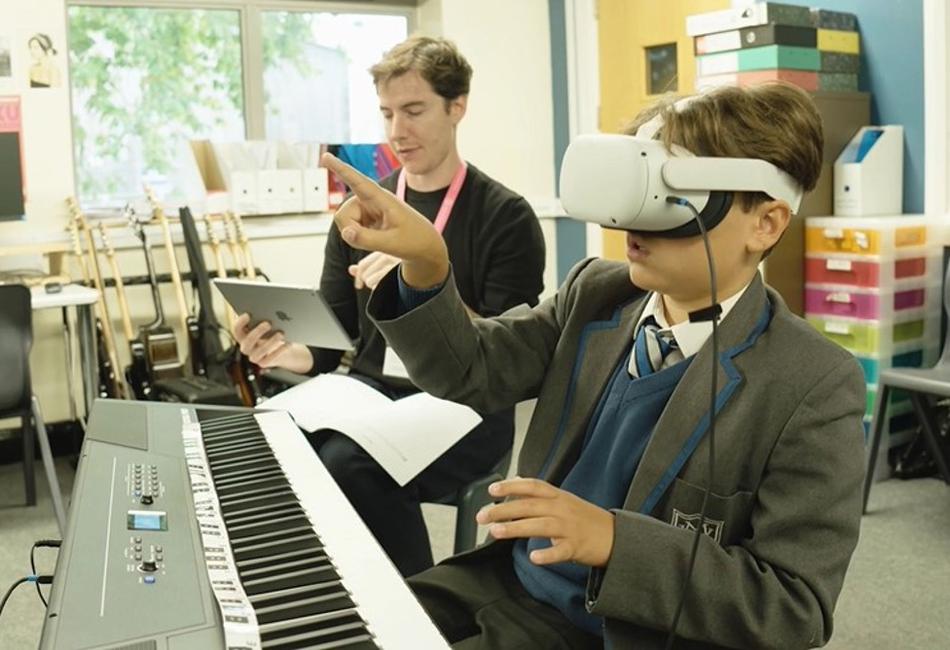
Pianol learning had always been based on physical presence, printed sheet music, and verbal instruction, over the centuries. Though the medium has incorporated things like apps and digital pianos, the essence has not been changed significantly. In the recent past, however, an additional dimension has started emerging in the field of piano education. The visual guidance that augmented reality brings directly to the instrument is a combination of the physical world and the digital world, that was not possible to imagine before.
Augmented reality supplements the real environment unlike virtual reality that replaces the physical environment. This information that is digital in nature is displayed on or around the keyboard as the pianist is playing a real instrument in the learning of piano. It is now possible to have notes, finger position, rhythm indicators, and feedback in the field of view of the player.
This is not a new trend that involves the replacement of teachers and traditional methods. It is concerning the redefinition of the delivery and perception of information at the piano.
The reason Why Traditional Piano Learning is visually restricted
Visual translation has always been very critical in the learning of piano. Learners will examine sheet music, and then their attention will be shifted to the keyboard followed by the page. This persistent motion separates focus and slows the understanding particularly with novices.
Most of the learners have problems not because they are not musically gifted but because they have difficulties in linking abstract symbols on paper to physical action on the keys. This disengagement usually causes frustration, low pace of progress and demotivation.
This issue is resolved by augmented reality which puts visual information in the place of its greatest need, the point of action.
The appearance of augmented reality piano learning
It is common in an augmented reality piano arrangement, with smart glasses, tablets, or projectors used by the learner to appear on the keyboard. There can be notes above certain keys and they light up one after another. The keys can be marked directly with finger numbers. The timing cues may be placed visually along the keyboard.
The learner does not need to figure out what to play and when to play it because he/she can see it and thus understand it mentally. This immediacy lowers the load on the cognition and creates the possibility to concentrate on sound and movement.
The interface and instrument are identical; the piano.
The reasons why this method is attractive to learners in the modern context
Contemporary students are used to feedback that is interactive. There are video games, fitness applications and language platforms that are instant in visual responses. Learning piano in classical manner is often stagnant.
AR brings out responsiveness. Learners can be visually confirmed a note or timing. Errors are brought out without affecting the flow.
This receptiveness generates involvement. Practice is more interactive than it is repetitive, which is in line with the current learning expectations.
The use of AR by beginners to overcome initial frustration
Piano learning is discouraging at the initial stages of learning. Novices have issues with hand coordination, note recognition and rhythm at the same time. The augmented reality is simpler as it helps in concentrating on a step-by-step basis.
AR avoids overload by displaying only the necessary thing at a particular time. Students develop confidence within a short period of time since they feel that they can achieve success during the initial session.
This confidence at early age is essential. It improves the chances of less experienced individuals to persist as opposed to quitting.
The AR-Based Learning Role of Muscle Memories
Excessive dependence is one of the concerns of visual guidance. Nevertheless, the augmented reality systems are developed in such a way that they can be supported step-by-step.
The muscle memory is created automatically as the learners repeat the movements on correct visual information. With time, cues are no longer needed. The body has memorized patterns and the mind knows structure.
AR reinforces muscle memory as opposed to substituting it when applied intelligently.
The way AR can transform practice efficiency
Old wisdom usually concurs with reoccurring errors, which are corrected afterwards. This is minimized by augmented reality that corrects the errors as they happen.
This efficiency not only reduces the time of practice, it also enhances quality. There is reduced time wasting in guessing and more time in refining by learners.
This is especially useful in busy adults or students who have only a small window in which to practice.
The reason Adult Learners are attracted to AR Piano Learning
Augmented reality piano systems have a large target market in adult learners. Adults are unhappy with slow advancement or learning mistakes.
AR provides a facilitative and supportive learning setting. Judgment is not made but guidance. Adults are able to learn at their convenience without any feeling of lagging behind.
This sense of psychological safety causes learning to be friendly and not threatening.
The way AR Benefits Visual and Kinesthetic learners
Not every learner takes in the information in the same manner. There are those who learn through sight and others through action. AR promotes the two at the same time.
Clear cues are an advantage to the visual learners. Kinaesthetic learners like a hands on instantaneous interaction. The amalgamation enhances knowledge.
This is a multi-sensory method which is more efficient in meeting the needs of learning than one dimensional teaching.
Why AR Is not a Replacement of Musical Understanding
Another myth is that augmented reality eliminates the concept of musical thinking. As a matter of fact, it helps understand through revealing relationships.
The learners continue to listen to harmony, experience rhythm and grow to express. AR just eliminates redundant elements in the initial phases.
Deeper musical concepts become accessible with advancement of skills since the exploration of the musical concept becomes easier.
The Effect of Sight-Reading and Timing
Sight-reading can be enhanced by AR because the visual representation of note-key association can strengthen the connection between the two. These relationships prove to be internalized by the learners, and with time, they become less dependent on overlays.
Accuracy of rhythm is also enhanced by timing cues. The use of visual motion will enable the learners to predict beats instead of responding in a slow manner.
These enhancements are carried over to the traditional reading and performance situations.
The response of Teachers to AR Piano Tools
AR is not considered by many piano teachers to be a substitute. Others incorporate it in home practice but carry on the traditional lessons in musical interpretation.
According to the teachers, students that use AR tools present themselves in a better manner and with more confidence. Lessons may be aimed at expression and not correction.
Such cooperation between technology and teaching improves learning.
Limitations and Concerns of AR Piano Learning
AR does not have no flaws. The issue of hardware price, complexity of setup and screen weariness are still a problem.
It is also possible that the learners become dependent because they do not switch to independent reading and listening.
Balance needs to be taken in responsible use. AR must lead and not control the learning process.
The reason why this technology is still new
AR piano learning is in its infancy although it holds potential. Hardware keeps on developing. Software advances are developing at a very fast pace but are experimental.
With the growing lightness, affordability, and accuracy of the devices, there is an increase in the adoption.
The trend is not volatile, but it is stable.
The AR as a part of the greater future of piano education
AR belongs to a larger change in direction to blended learning. The teaching of piano is taking a direction to the systems that integrate the use of physical instruments, digital feedback, and human instructions.
AR provides a graphical overlay to this ecosystem. It enhances the use of apps, teachers and traditional practice as opposed to substituting them.
The future of the piano learning is not linear, but stratified.
The importance of this trend to the evolution of the piano
The piano has managed to survive through the centuries, as it is adaptable. Since mechanical innovation, to digital transformation, it is ever evolving without being made up.
Another form of adaptation is augmented reality. It admires the physical tool and improves knowledge.
Such a balancing has seen to it that the piano still holds its position in a dynamic educational environment.
The Long-term Effect on the Learners
Students who are introduced to AR at an early age tend to gain confidence in a shorter period. They relate learning of the piano to understanding and not confusion.
This such healthy relationship promotes sustained interaction. The learners will be more inclined to study repertoire, technique, and creativity.
AR does not make musicians and it eliminates redundant challenges.
The reason why AR Piano learning is a trend to observe
This is a trend that can be observed in the general shift in the way individuals anticipate acquiring complex skills. Interactivity, personalization and visual feedback are becoming the norm.
Piano education is reacting to the same. AR is among the most potentially interesting developments in this response.
Its expansion might be slow yet its impact is large.
Conclusion
AR is starting to transform the way an individual learns the piano by introducing visual instructions directly on the instrument. AR provides a new experience of interacting with the piano by lowering mental barriers, increasing efficiency, and giving confidence.
This technology is not a substitute of tradition. It enhances it. AR can put the process of learning piano more approachable and enjoyable than ever before when used in combination with listening, expression, and human instruction.
The future of the piano is not in forgetting the past and embracing innovation blindly. AR is one step towards that direction.
More from the blog
Keep exploring new ideas
Piano: Psychological Development.
How Piano Learning Improves Memory Over Time
The process of learning, adaptation, and growth of people is mainly driven by memory. Learning Piano has emerged as one of the effective techniques of memory reinforcement via formal repetition, auditory, coordination and recalling over time. This article discusses the process by which practicing piano develops various forms of memory, reasons why these advantages become increasingly more effective, and how the benefits of learning a piano help to retain in the minds of non-musical areas.
Piano & Skill Development
How Piano Practice Builds Consistency and Self-Discipline
Self-discipline and consistency are crucial personal qualities in the contemporary life but are becoming more challenging to master. The learning of piano provides a natural and effective method of developing both in a structured form of learning, in a progressive manner and through long term commitment. This paper will examine how practice in the piano will develop the consistency over the time, why the self-discipline will develop naturally at the instrument and the applicability of these abilities far beyond music in the life.
Piano & Lifelong Learning
The Reason behind the Rise of Piano Learning among Mature Beginners in the world.
The world has witnessed a potent surge in piano learning among adult learners. More individuals are learning the piano later in their lives and this is due to the flexibility of digital tools, lifestyles and now people are more focused on their personal development. The article discusses the reasons why this trend is being experienced, how adult learners treat piano differently, and why this trend is transforming the contemporary culture of the piano.
Piano & Modern Skills
The reason Learning Piano Is Better than Multitasking in a Distracted World.
Piano learning is becoming an effective tool to reconnect attention and deep thinking in a day and age where we are bombarded with notifications and do not spend enough time in deep contemplation. The mental clarity ensured by years of discipline in the practice of the piano may be that which is afforded by very few activities because it demands constant focus, physical coordination and active listening. This paper discusses the connection between learning the piano and attention, the level of cognitive and mental discipline and the reason why more and more individuals are turning to the piano to overcome distraction in the modern world.
The Culture of Piano and Contemporary Music.
The reason why Minimalist Piano Music is becoming a sound of this decade.
The minimalist piano music has come out as one of the most effective sounds of the modern age. The style is marked by its simplicity, repetition, and restraint, and they are defining the manner in which individuals listen, create, and relate to piano music nowadays. This paper delves into the reasons behind the growth of minimalist piano in popularity all over the world, its reflection of the contemporary life, and why it is a simply a new voice of this decade.
Piano & Music Industry
Why Artificial Intelligence-Composed Piano Music Is Overwhelming Streaming Services.
Piano music generated by AI is quickly spreading through the streaming platforms, and it is often hard to distinguish between the music written by humans and the music created by AI. Artificial intelligence is slowly transforming the nature of the creation, distribution, and consumption of piano music, whether it be ambient playlists or movie piano sounds. In this article, the author examines the reasons behind the trend of AI piano music, its impact on actual pianists, and what this change could imply on the future of piano art.