
When you look at a piano for the time piano can feel confusing. All keys look alike. The good news is that piano keyboard layout is built on a simple pattern. Once you learn this pattern whole keyboard starts to make sense. Every piano, from a portable keyboard to a full concert grand follows the same basic design so skills you build on piano will carry over to any other piano you play.
The essence of this design lies in a pattern that keeps repeating itself with black keys. The white keys receive their names according to the seven alphabetical letters A to G. These seven names continue to repeat endlessly from left to right on the keyboard. Groups of black keys alternate between two and three keys. This alternation serves as a kind of landmark because of which one can immediately know where to look for the right key without counting the keys or reading any labels. for more updates about the musical instruments join us
What Is a Piano Keyboard Layout?
A piano keyboard layout is the arrangement of black keys in a long line. Each piano keyboard layout key produces a sound. The keys on the side produce low notes while the keys on the right side produce high notes.
The piano keyboard layout might seem long and confusing, at first.. In reality it is just a small cycle of 12 keys that repeats itself over and over. That cycle contains 7 keys and 5 black keys. Once you master this 12‑key cycle you have mastered the piano and the piano keyboard layout becomes second nature.
The Seven Note Names on the White Keys
The white keys use seven letters from the alphabet: A B, C D, E, F and G. When you get to G the pattern starts over again at A.
That means no matter how big or small the piano is you never need more than seven letter names. For example a low C and a really high C both have the same name. They’re the same note just played at different pitches. This repeating pattern is the foundation of every piano keyboard whether it has 49 keys or 88 keys.
Understanding the Black Keys
The black keys are between and above the keys. They come in groups. Two keys together then three, then two again. This pattern is like a map. If you know it you can find any key without needing to look for labels.
Each black key has two names. That’s because it can be either a sharp or a flat. Here are the pairs:
• C sharp or D flat
• D sharp or E flat
• F G flat
• G sharp or A flat
• A sharp or B flat
A sharp (♯) means the note is one step higher than the white key next to it. A flat (♭) means it’s one step lower. The sound is the same. Only the name changes depending on the key or the song you’re playing.
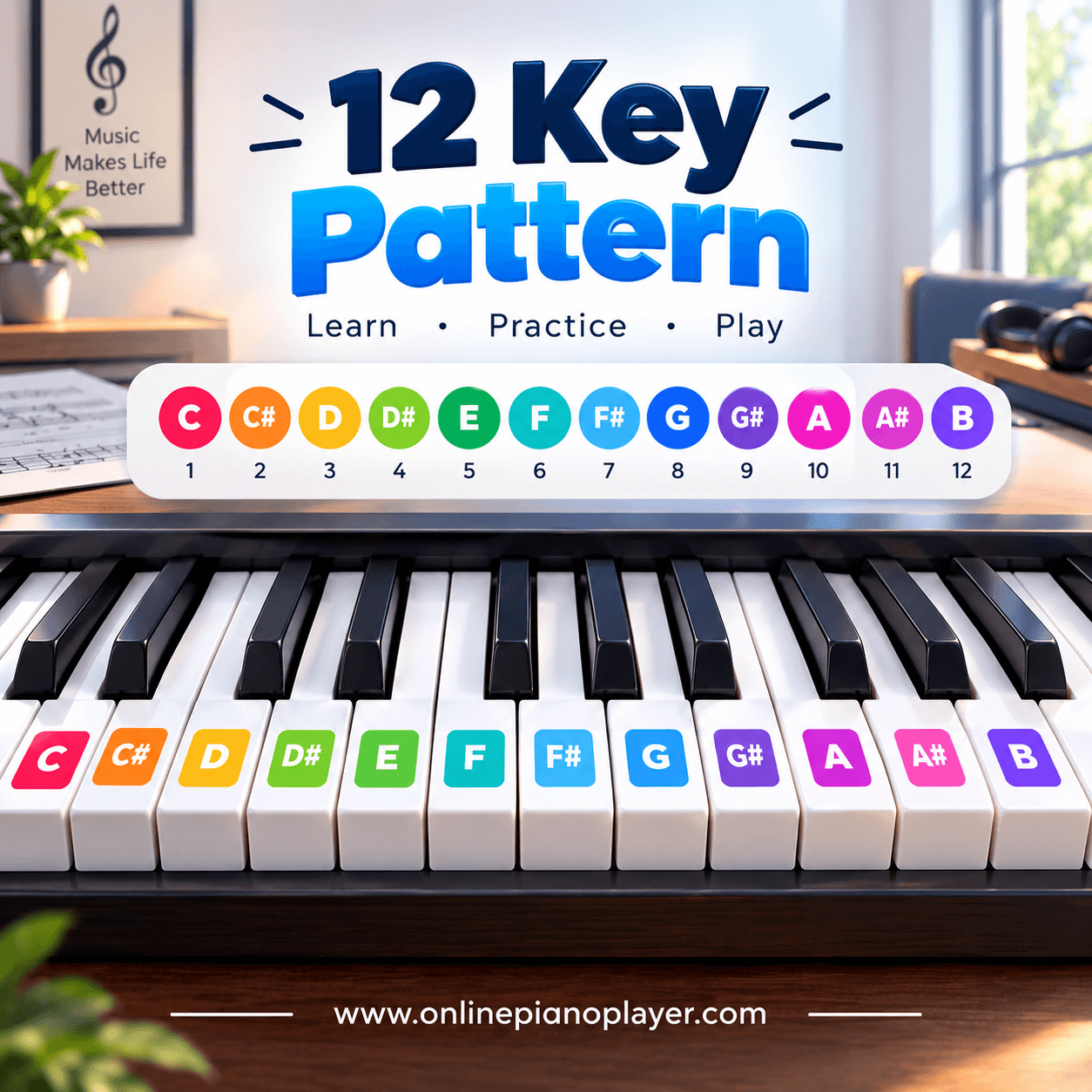
The 12-Key Pattern
If you play every key in order from any C you’ll get twelve notes before the pattern repeats:
C, C sharp or D flat D D sharp or E flat E, F, F sharp or G flat G, G sharp or A flat A, A sharp or B flat B
Then the next note is C again and the pattern starts over. This full set of twelve notes is called the scale. Every piano keyboard is built from this set repeated across the keys. A size acoustic piano repeats this 12-note pattern a little, over seven times.
What Is an Octave?
An octave is the distance between one note and the next note that has the name. For example going from one C to the C is one octave. An octave includes 12 keys—7 keys and 5 black keys.
When you play two notes that're an octave apart they sound very much alike even though one is higher in pitch. That’s why musicians say the notes "match." Understanding octaves helps you move quickly and around the keyboard.
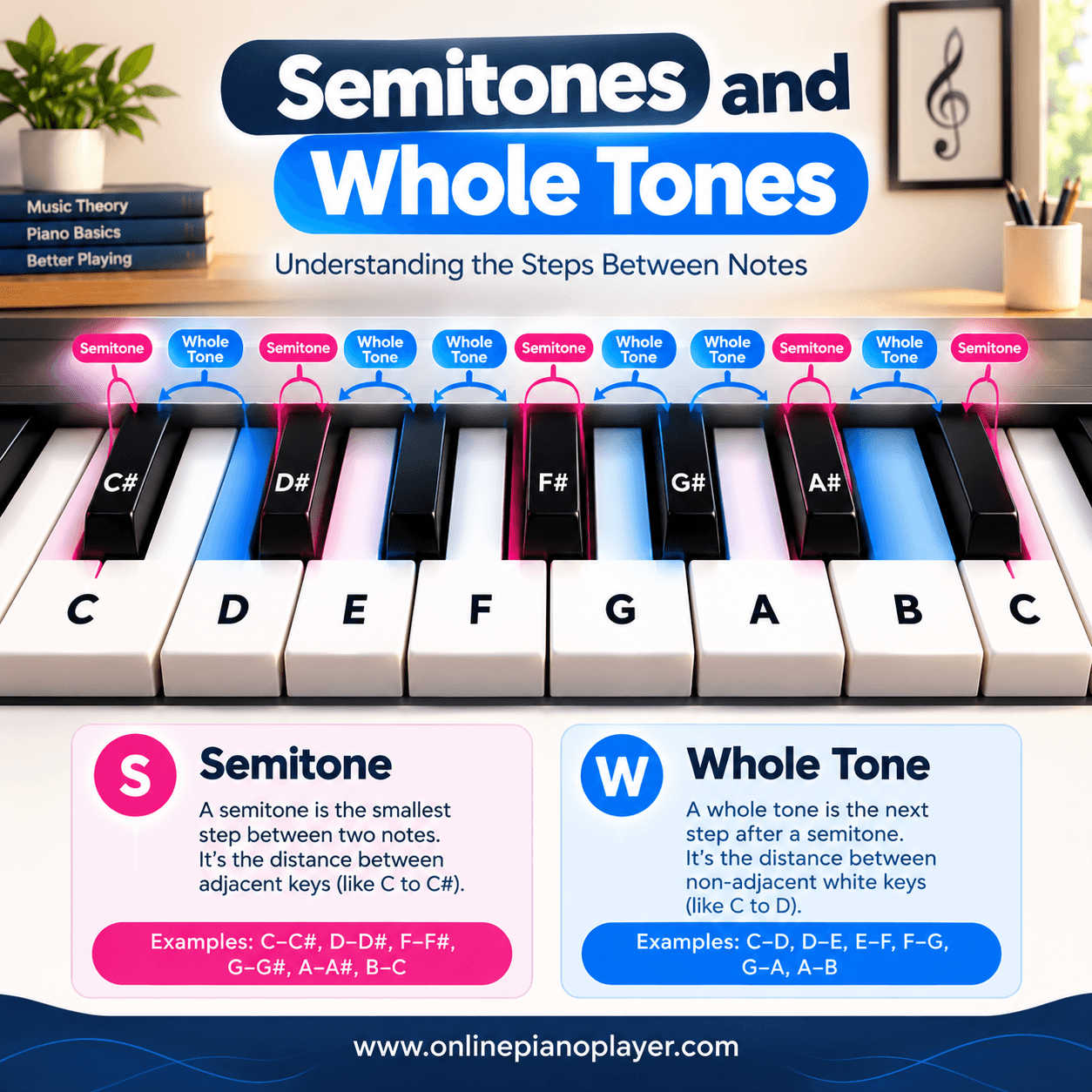
Semitones and Whole Tones
To understand sharps and flats you need to know two ideas.
Semitone ( step): This is the smallest space between two notes in Western music. It is the distance from one key to the next key no matter if it’s white or black. For example the jump from C to C♯ is one semitone. The jump from E to F is also one semitone because there is no key between E and F.
Whole tone (whole step): This is two semitones. For example the distance from C to D is a tone. The same goes for D to E and F to G. These little distances—semitones and whole tones—are the building blocks of scales and chords.
How to Find Any Note Using the Black Keys
You don’t have to memorize every key. Here are two simple tricks that make finding notes easy:
1. Find C: C is the key just to the left of every group of two black keys.
2. Find F: F is the key just to the left of every group of three black keys.
Once you find C or F the rest of the notes are easy. Just count up in order: C, D, E, F, G, A B. Remember that there is no black key between E and F or between B and C. That’s important. Keep that in mind. You won’t get lost.
A quick practice exercise: place your finger on any group of two keys and then say the note names out loud as you move to the right. Try this on parts of the keyboard. After a few days of doing this the layout will start to feel natural. You’ll know where every note is, without thinking.
Where Is Middle C?
Middle C is the C that's closest to the centre of an 88-key piano. It is not the middle but it is the most central C. Middle C is one of the most important keys to learn. In sheet music Middle C sits directly between the two staves of the staff. Middle C is written on a line below the treble clef and above the bass clef. Notice that the Middle C in the clef and the Middle C in the bass clef are the same note. Middle C is the meeting point of both hands. For beginners Middle C is usually where the right thumb sits when you first learn to play. Finding Middle C quickly gives a home base on the keyboard.
Easy Tips to Learn the Keyboard Layout Fast
Here are some ways to remember the piano keyboard layout:
• Use repetition. Practice for ten to fifteen minutes each day. Short regular sessions are better than one session.
• Name the notes aloud. Say each name as the key is pressed. This connects the eyes, ears and fingers.
• Start with C major.
• Use. A printable chart.
• Learn the groups.
• Play songs.
Common Mistakes Beginners Make
• Thinking every key has a name. Remember that seven letters repeat.
• Forgetting that black keys have two names. C♯ and D♭ are the key.
• Ignoring E–F and B–C. These pairs have no key between them and they are only one semitone apart.
• Memorising one key at a time.
Concluding Remarks
The keyboard of a piano may appear large. However, it is actually a repetitive pattern of twelve keys. The learning of the names of the seven keys and locating the group of two and three keys will enable a person to locate the middle C note on the keyboard. It takes just these three things for a person to figure out how to navigate a keyboard. The more practice you do with the keyboard, the more comfortable it becomes, like an alphabet.