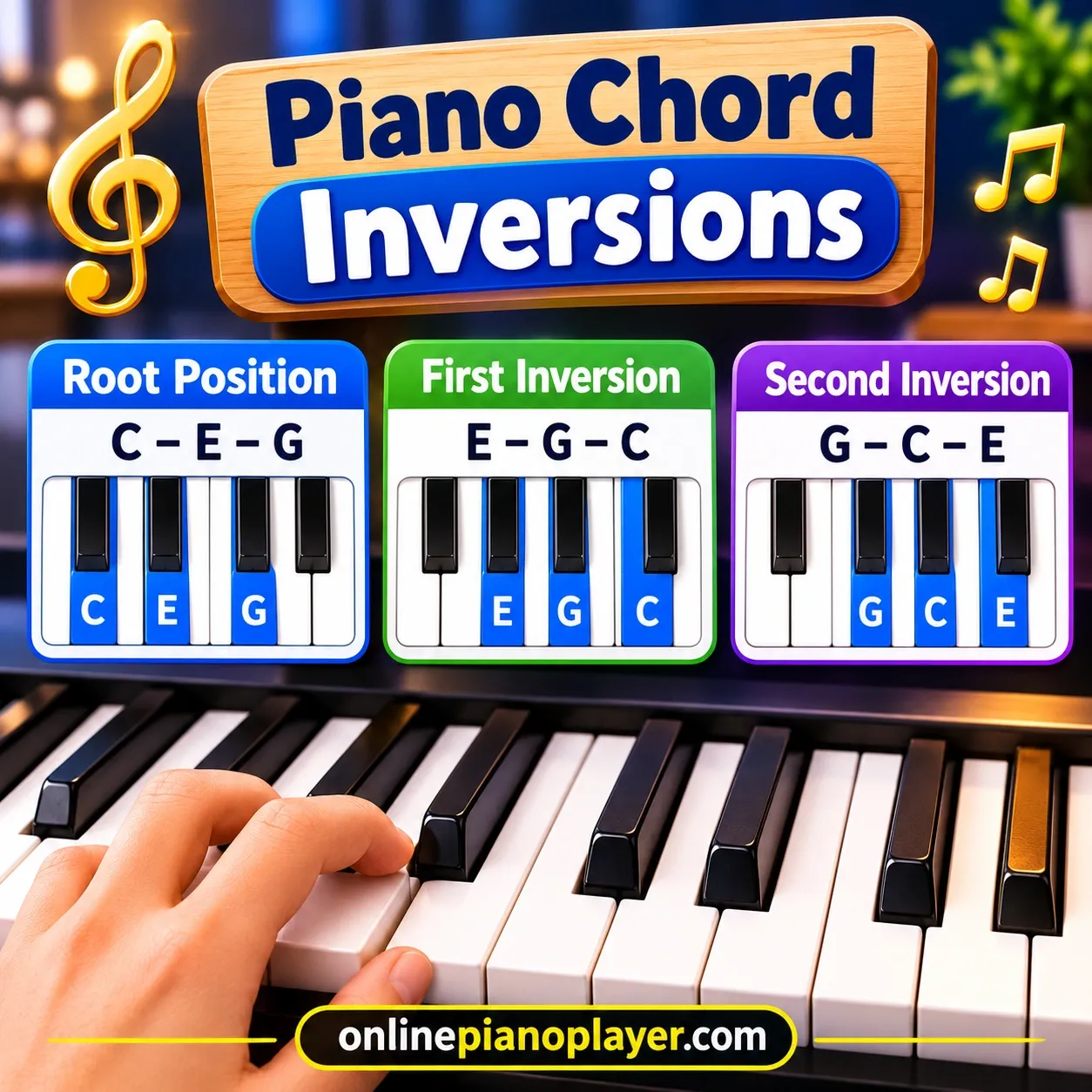
When started playing the piano, the first chords we learn are basic chords. We press down a few keys and enjoy the sound. However we can play the same chords but just change the notes around! These are known as chord inversions.
The chord inversions are useful as they allow smooth transitions between chords and make your playing sound more fluid. They are easy to understand and do not require any complex music theory. Having a few examples will help you understand chord inversions. For more updates keep connect with us.
What are chord inversions?
A chord inversion just means arranging the notes from a chord to be in a different order. Take the C major chord. This chord contains three notes:
- C
- E
- G
Playing all of these together will put the chord back to its original position (root). To make a chord inversion we will move the bottom note up to the top.
As we still are only using the same notes, we are still using the C major chord. We have just reordered t
Types of Chord Inversions
Sometimes we will come across three note chords. These are known as triads. There are three main positions within triads. They are:
1.Root
As expected the root position is the basic form of a chord. The first note will always be the root note. Looking at our C major chord.
C – E – G
We can see that the bottom note is the C. This makes it a root chord. If you’re just starting out then this is a good place to begin!
2.First Inversion
With a first inversion we will take the bottom note and put it on the top of the chord. The third note will now become the new bottom note.
This will take our C major chord notes:
C – E – G
And make them:
E – G – C
Our bottom note will now be E. We are still playing the same chord just in a different position.
3.Second Inversion
Once we’ve done our first inversion we can move the bottom note up again. This makes:
G – C – E
Our new bottom note will be G. We now have the second inversion. These three inversions can be practised so we can understand how to play the chords in different ways.
How to Read Triad Chord Inversions?
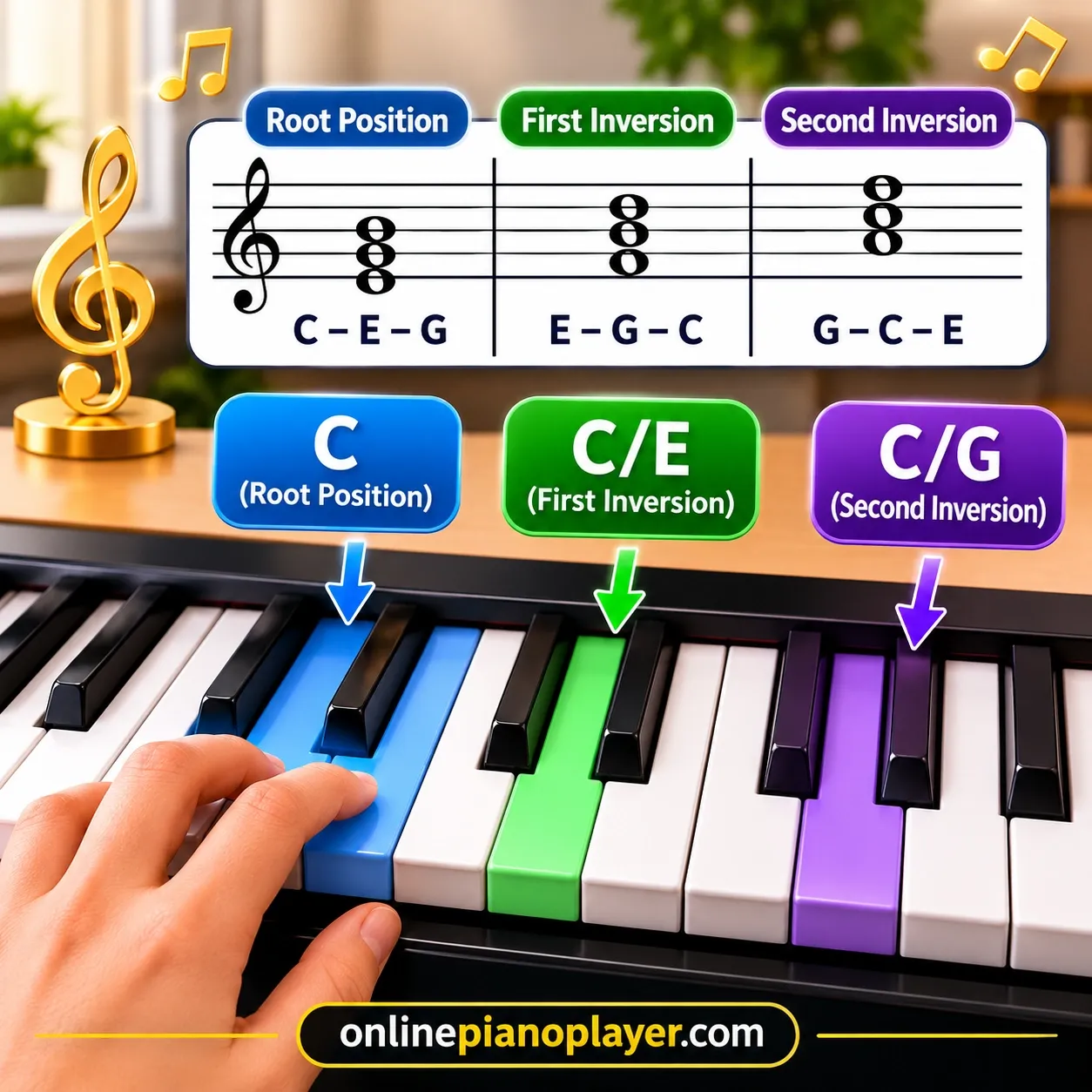
Triad chord inversions are read based on the bottom note of the chord. In each case there are the same 3 notes but played in different orders. C-E-G is root position, E-G-C is 1st inversion and G-C-E is 2nd inversion.
They might also be written as C, C/E and C/G. The letter after the slash shows you which note to play at the bottom. Once you understand the basic rule it makes reading chord symbols much easier and playing different chord positions on the piano.
How to Practise Chord Inversions
The easiest way to understand chord inversions is by practising on your piano. Start with a single chord and move slowly through the three inversions. Step by Step:
Find your notes:
Find C, E and G on your keyboard and play them together.
Root position:
Using your right hand play the C, E, and G. Make sure you can hear all three notes.
First Inversion:
Move the C up a note. You should now be playing E, G, and C.
Second Inversion:
Move the E up a note. You should now have G, C, and E.
When to Use Chord Inversions
There are many times when chord inversions can be useful in piano music. They make playing chords easier.
Common times include:
Smooth chord changesSometimes when changing chord we have to move our hands over several keys. Using chord inversions can help us move less by choosing a close inversion.
Playing Songs
Many songs use the same chords throughout. Chord inversions will give you more options and help you move smoothly between chords.
Piano Accompaniment
If you’re singing while playing piano, chord inversions will help you keep your hand in a comfortable position. They can also be useful when playing with other instruments.
Improved Hand Movement
Sometimes you won’t need to go back to the root. Choose the closest inversion and improve your playing.
Different Sounds
Although the same notes are being played, the bottom note will change. This can give the chord a different feel.Giving you more control over your music.
Final Thoughts
As you can see, chord inversions aren’t as tricky as they look. All you’re doing is rearranging the order of your notes. Once you understand the three main positions you can use them in lots of songs.
Start with C Major and work through each inversion slowly. Then move onto other major and minor chords. With regular practise you’ll find it easier to change chords and your playing will be much smoother. Don’t worry about learning it all at once! Take your time and enjoy playing!
FAQs
1.How many inversions do triads have?
Triads have two inversions. A first inversion and a second inversion. Along with the original, root inversion.
2.Do inversions change the name of the chord?
No, we still use the same chord name as we are using the same notes. The order of the notes has just changed.
3.Which chord is best to practise inversions?
C Major is a great chord to start with. As it only uses white notes, C, E and G.
4.Can minor chords have inversions?
Yes! Minor chords have root, first inversion and second inversion. You just follow the rules but with different notes.
5.Are chord inversions important for beginners?
Yes! Chord inversions will help beginners understand chords, make it easier to move your hands and help songs sound smoother.
6.How often should I practise chord inversions?
Start with practising for 5-10 minutes. Make sure you understand how to play each inversion before speeding up.