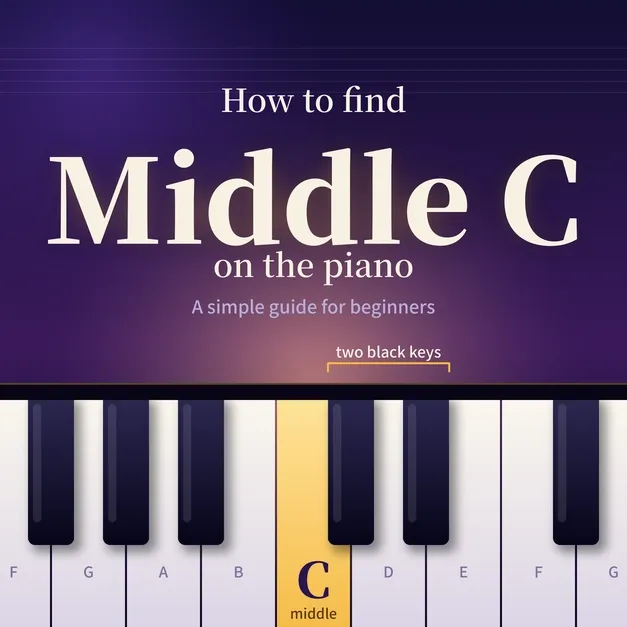
One of the first things that you will hear if you have just begun learning piano is "find middle C." It sounds more like a chore, but in reality, this will be your starting point when you learn anything else. Once you locate middle C the rest becomes much clearer.
Finding C is an easy task. You do not have to be able to read music, you do not have to possess any skills, you just need your eyes and your ears. In this article, you will learn what middle C is and how to find it on any piano and keyboard. for update and learn musical instruments then join our community
What Is Middle C?
Middle C is a note on the piano. It is called "middle" because it sits near the center of a full-size piano keyboard. It is also called C4 because it is the C key counting from the left side of an 88-key piano.
The letter C is the name of the note. The piano uses seven letter names: A B, C, D, E, F and G. After G the names start over again at A. This means there are many C keys on a piano, not just one. Each one sounds higher or lower than the others. They all share the same name and a similar "feel." Middle C is simply the one that's closest to the middle.
There are two reasons why middle C's so important:
• It is a home base. Most beginner songs start near C. When you know where it is you can find other notes quickly.
• It connects the two hands. Middle C is the note where the left hand and right hand often meet, both on the keyboard and in sheet music.
First Learn the Pattern of Black and White Keys
Before you look for C you need to understand how the keys are arranged. A piano has keys and black keys. The black keys are not spread out evenly. Instead they come in two kinds of groups:
• Groups of two keys
• Groups of three black keys
This pattern repeats from the left side of the piano to the right side. Look at your keyboard now. You will see two keys, then a gap, then three black keys, then a gap, then two black keys again and so on.
The Easy Trick: Find C Using the Two Keys
Here is the simplest way to find any C on the piano:
1. Look for a group of two keys.
2. Find the key directly to the left of the first black key in that group.
3. That white key is C.
That is it. Every group of two keys has a C just to its left. Say it loud as you point: "C is on the left of the two black keys." Try it a few times. Find a group of two keys somewhere on the piano. Put your finger on the key to the left of them. Press it. You have found a C.
Other notes are easy to find from here. The white key between the two keys is D. The white key to the right of the two black keys is E. So the first three notes in the group are C, D and E.
Why There Are Cs and Which One Is Middle C Drag?
Because there are many groups of two black keys on a piano there are many Cs. A full-size piano with 88 keys has eight of them. So how do you know which one is C?
On a full-size piano middle C is the C that's closest to the center of the keyboard. Here is a simple way to find it:
1. Sit directly in front of the piano with your body lined up with the center.
2. Look ahead at the keys in front of you.
3. Find the group of two keys that is closest to the center.
4. Put your finger on the key just to the left of that group.
That key is C.
On many pianos the brand name is printed in the middle of the piano just above the keys. This can help you find the center. Middle C is usually right near that spot.
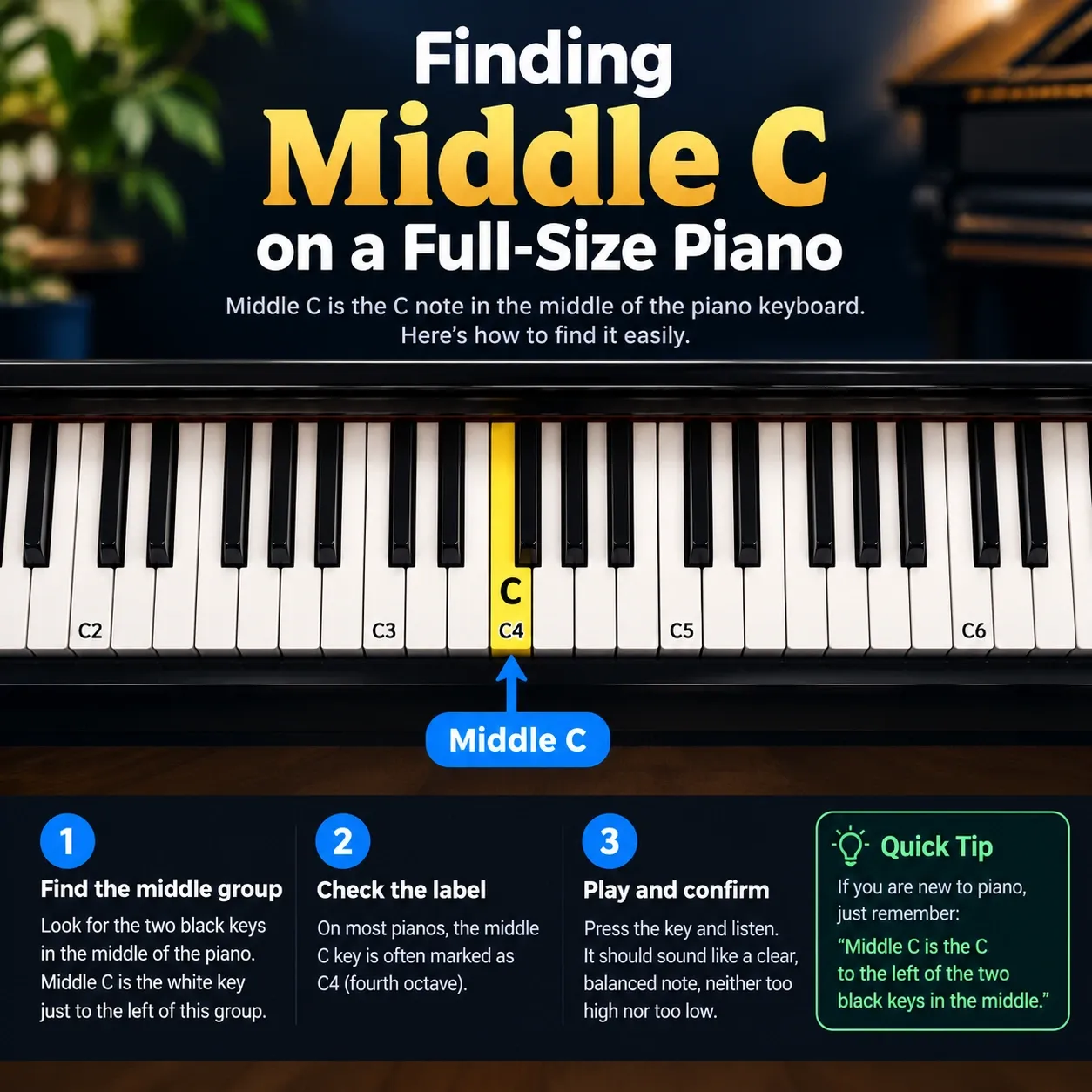
Finding Middle C on a Full-Size Piano
Lets go through it slowly from the beginning.
Step 1: Sit in the middle. Sit on the bench with your belly button lined up with the center of the keyboard. Keep your back straight. Your arms relaxed.
Step 2: Look for the key groups. Let your eyes move over the keys. Notice the twos and the threes.
Step 3: Find the two-black-key group near the center. There will be one directly in front of you or very close to it.
Step 4: Find the key to the left. Put your thumb on the white key just to the left of those two black keys.
Step 5: Play the note. Press the key gently. Listen. You are now playing middle C.
Finding Middle C on a Keyboard
Not everyone has a full-size piano. Many people start on a keyboard with 61 keys 49 keys or even 25 keys. The trick still works,. The center" is a little different.
On a 61-Key Keyboard
A 61-key keyboard has five octaves. Middle C is usually the C from the left. Count the Cs by finding each group of two keys and looking to the left of it. The third one is C. It is close to the center of the keyboard.
On a 49-Key Keyboard
A 49-key keyboard has four octaves. Middle C is usually the C from the left as well or sometimes the second depending on the model. If you are not sure check the middle of the keyboard. The C closest to the center is a guess.
On a 25-Key Keyboard
Small keyboards often have two octaves. Middle C is usually the C or sometimes the first. Many small keyboards have buttons that let you shift the octave up or down. This can change which key plays C. So if your keyboard has an octave button make sure it is set to the setting.
A Tip for All Keyboards
if you want to be sure look at the instruction booklet. Search the model name online. Many keyboards also have a mark or label on middle C. Some people put a sticker on the key to help them remember.
Use Your Ears Too
Your eyes are not your tool. You can also use your ears.
Middle C sounds neither very low nor very high. It sits in a spot in the middle of the sound range. If you press a key and it sounds very deep and rumbly you are far to the left. If it sounds very thin and tinkly you are far to the right.
Play a C on the left of the piano and then middle C. Then play a C on the right. You will hear that they all sound alike in some way. They are higher or lower. This is called an octave. An octave is the distance from one note to the note with the same name.
Easy Ways to Remember Middle C
Here are some tricks that can help you remember where middle C is:
• "C is to the left of the two black keys." Say this to yourself every time you sit down.
• "Middle means near the middle." Use the center of the piano, where the brand name's as a clue.
• Use a sticker. Place a removable sticker on the key. Take it off after a week or two once you know the spot by heart.
• Say the name as you play. Press the key. Say "C" out loud. Hearing and seeing the name together helps your brain remember.
• Draw it. Draw a picture of the keyboard and mark the two-black-key groups. Then put a star on middle C.
Common Mistakes to Avoid
Everyone makes mistakes at first. Here are a few ones and how to fix them.
Mistake 1: Picking the group of black keys. Some beginners look for the three-black-key group by accident. Remember that C goes with the group of two. If you land on a key that is to the left of three black keys you have found F instead.
Mistake 2: Choosing the key on the wrong side. C is on the left of the two keys not between them or to the right. The key between them is D.
Mistake 3: Not sitting in the middle. If you sit off to one side the "center" will look different. Always sit in the middle of the keyboard to begin with.
Mistake 4: Forgetting about the octave setting. On keyboards the octave button may be changed. If the sound seems high or too low check this setting.
Mistake 5: Giving up soon. Finding C can feel strange at first. Keep practicing for a minutes each day. It will become natural quickly.
Final Thoughts
Finding C is one of the easiest and most useful things you can learn on the piano. Remember the idea: look for a group of two black keys and C is the white key just to the left. Middle C is the one, near the center of the keyboard.
Once you know middle C you have a home base. From there you can find D, E, F, G, A and B. You can place your hands in the spot. You can start reading music.. You can begin playing your first songs.